

Optical encoders measure motion without physical contact by evaluating fine periodic structures on a scale. The resulting changes in light intensity are converted into electrical signals. This makes them highly suitable for precision motion systems, because the measurement itself does not introduce friction, wear or mechanical load into the positioning setup
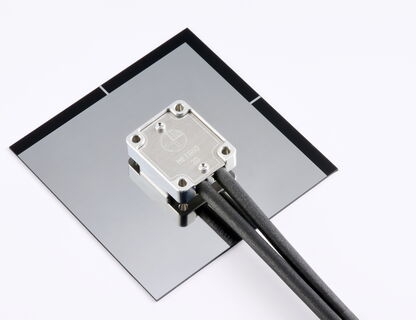
In the METIRIO® Encoder, an integrated light source illuminates a reflective scale with a fine periodic grating. As the scale moves relative to the read head, the reflected light pattern moves along with the motion of the system. This movement of the pattern is detected by photosensors inside the read head and converted into analog sine and cosine signals. These signals contain the information required to determine the current displacement relative to a reference, the direction of movement and the velocity of the motion.
From Light Pattern to Position Information
Three physical effects are central to this process: The moiré effect, Talbot imaging and the Lau effect. Together, these effects allow METIRIO® to operate without relying on conventional imaging optics. This is a major advantage for miniaturized encoder systems, because classical lenses would increase the required installation space and add alignment complexity. By using the optical behavior of gratings and structured light patterns directly, the encoder can remain compact while still providing precise motion feedback.
The change in brightness distribution during movement serves as a signal carrier. An array of well desgined photodiodes translates into sine and cosine signals, which are then used to calculate the position within one scale period and to determine the direction of travel.
METIRIO Readhead & Encoders

METIRIO® Readhead

METIRIO® D1c
METIRIO® 2D
Physical principles of an optical encoder
Moiré Effect: Making Small Displacements Visible

The easiest way to create a moving intensity pattern is by moving two periodic patterns relative to each other. Even if the original structures are extremely fine, their overlap can create a much larger visible pattern. This larger pattern changes strongly when one of the original structures moves by only a small amount. For measurement systems, this makes the Moiré effect a powerful way to translate tiny displacements into detectable signal changes.
In the METIRIO® Encoder, the Moiré effect contributes to the conversion of microscopic motion into a measurable optical signal. It detects how the brightness pattern changes as the scale moves. This makes it possible to derive precise position information from very small mechanical movements.
The Moiré effect is therefore best understood as an optical translation mechanism. It converts fine scale displacement into a lower-frequency intensity modulation that can be evaluated electronically. This supports stable signal generation and helps the encoder achieve high-resolution position feedback in a compact optical setup.
However, this effect alone is not suffcient to build an optical encoder with nanometer resolultion, because the achievable signal period is strongly linked to the grating period and collimated illumination is required for sharp structures. Therefore additional interferecn effects are utilized.
Talbot Imaging: Self-Imaging of Periodic Structures

Talbot imaging is an optical diffraction effect that occurs when monochromatic coherent and collimated light illuminates a periodic grating. At specific distances behind the grating, the original grating structure reappears as a self-image. This means that the light field reproduces the periodic structure without the need for a conventional lens. The distance at which these self-images repeat is known as the Talbot length. Formula:
zₜ = 2d² / λ
Here, λ is the wavelength of the incident light and d is the grating period.
For optical encoders, Talbot imaging is valuable because it enables the optical evaluation of very fine periodic structures in a compact arrangement.
In the context of METIRIO®, this supports a compact read head architecture. The optical setup uses grating-based diffraction effects to generate very fine structures to create a stable, position-dependent intensity pattern.
However, the condition of coherent collimated light is much too demanding for a miniature optical encoder. Therefore, the use of an additional effect is critical.
Talbot-Lau Effect
Interference with a Compact Light Source

The Talbot-Lau effect extends the Talbot principle to light sources with low spatial coherence, such as compact LEDs.
In a Talbot-Lau arrangement, multiple periodic gratings interact through near-field diffraction. If gratings with matching periods are placed behind each other, self-images can be observed at specific propagation distances. In combination with Talbot imaging, this creates an interference pattern even though the source itself has only limited spatial coherence.
This is important because many practical encoder systems cannot rely on large or highly coherent optical sources. A compact encoder must generate a reliable optical signal in a small installation space, with components that are suitable for integration into motion systems.
However, this configuration is still limited because strict conditions on gratng persiods and positions have to be fulfilled. Furthermore, the created image may require optical lenses to be focused on the photo sensors.
Generalized Grating Imaging
Generalized Grating Imaging generalizes these principles. Two gratings, including gratings with different periods, can be arranged so that periodic pseudo-images arise at finite distances beyond the second grating
The configuration remains lensless, supports divergent or extended illumination, and provides greater freedom in the choice of grating periods, spacings, and system geometry. As a result, the principle is particularly well suited for compact optical encoders.
Analyser grating / Encoder readout

A third analyzer grating can be used to sample the pseudo-image produced by Generalized Grating Imaging. The overlap between the pseudo-image and the analyzer grating creates a magnified intensity modulation according to the Moiré principle, which can be captured by photodiodes or a sensor array.
Furthermore, the design oft he analyzer grating allows to control waveform, phase relation and higher harmonic influences.
Typical setup: G₀ → G₁ → G₂ → Detector
G₀ enables the Lau effect by dividing an extended, incoherent light source into many small partial sources. G₁ generates a pseudo self-image pattern through diffraction. G₂ acts as an analyzer grating that converts the fine Talbot fringe pattern into a detectable moiré intensity pattern at the detector plane.
In METIRIO®, this background helps explain how precise optical feedback can be achieved in a very small read head. The encoder uses the behavior of periodic structures and reflected light to generate signals that are sensitive to displacement pattern without requiring bulky imaging optics or a large coherent laser source, therefore remaining practical for real motion-system integration.
From Brightness to Sine and Cosine Signals
As the METIRIO® read head moves relative to the reflective scale, the optical intensity pattern shifts across the photosensors. The sensor arrangement converts this moving brightness distribution into two analog signals: a sine signal and a cosine signal. These two signals are phase-shifted by 90 degrees. This is a so-called quadrature signal.
Quadrature signals are highly useful in position measurement because they contain more information than a single periodic signal. A single sine signal can show that motion has occurred, but it cannot uniquely identify the direction of movement. By evaluating both sine and cosine together, the system can determine whether the movement is forward or backward and maintain the same sensitivity throughout a complete period.
For more information on signal Quadrature, see here: Displacement Measurements Using a Michelson Interferometer
The METIRIO® scale uses a 20 µm pitch. Therefore, one complete period of the sine and cosine signals corresponds to one 20 µm period on the scale.
Formula: x = (φ / 2π) · 20 µm | Here, φ is the phase angle in the Lissajous representation of the two signals.
This signal principle is the basis for high-resolution closed-loop feedback. This way, the motion controller can evaluates the phase within each period. This enables fine position interpolation and supports precise motion control, especially in applications where smooth positioning, repeatability and high dynamic performance are required.
Lissajous Figure: Position, Direction and Velocity

When the sine and cosine signals of an optical encoder are plotted against each other, they form a Lissajous figure. In an ideal case, this figure appears as a circle. The horizontal axis represents the cosine signal, and the vertical axis represents the sine signal. The current position within one scale period corresponds to the angular position of the signal point on this circle.
As the scale moves, the signal point travels along the circular path. One full rotation around the Lissajous circle corresponds to one full scale period. For a METIRIO® scale with 20 µm pitch, this means that one complete circular movement represents 20 µm of relative displacement between scale and read head.
The direction in which the signal point rotates indicates the direction of movement. If the scale moves in the opposite direction, the rotation direction reverses. The speed of rotation corresponds to the velocity of the motion. A slowly moving scale produces a slowly rotating signal point, while faster motion produces faster rotation.
The Lissajous representation is therefore a compact way to understand quadrature signal evaluation. It connects mechanical displacement, direction detection and velocity information in one visual model. In practical encoder evaluation, the quality of the Lissajous figure also provides insight into signal balance, phase accuracy and alignment quality.
This approach is also used in our ENCODER Evaluation MODULE.

Contact us!